
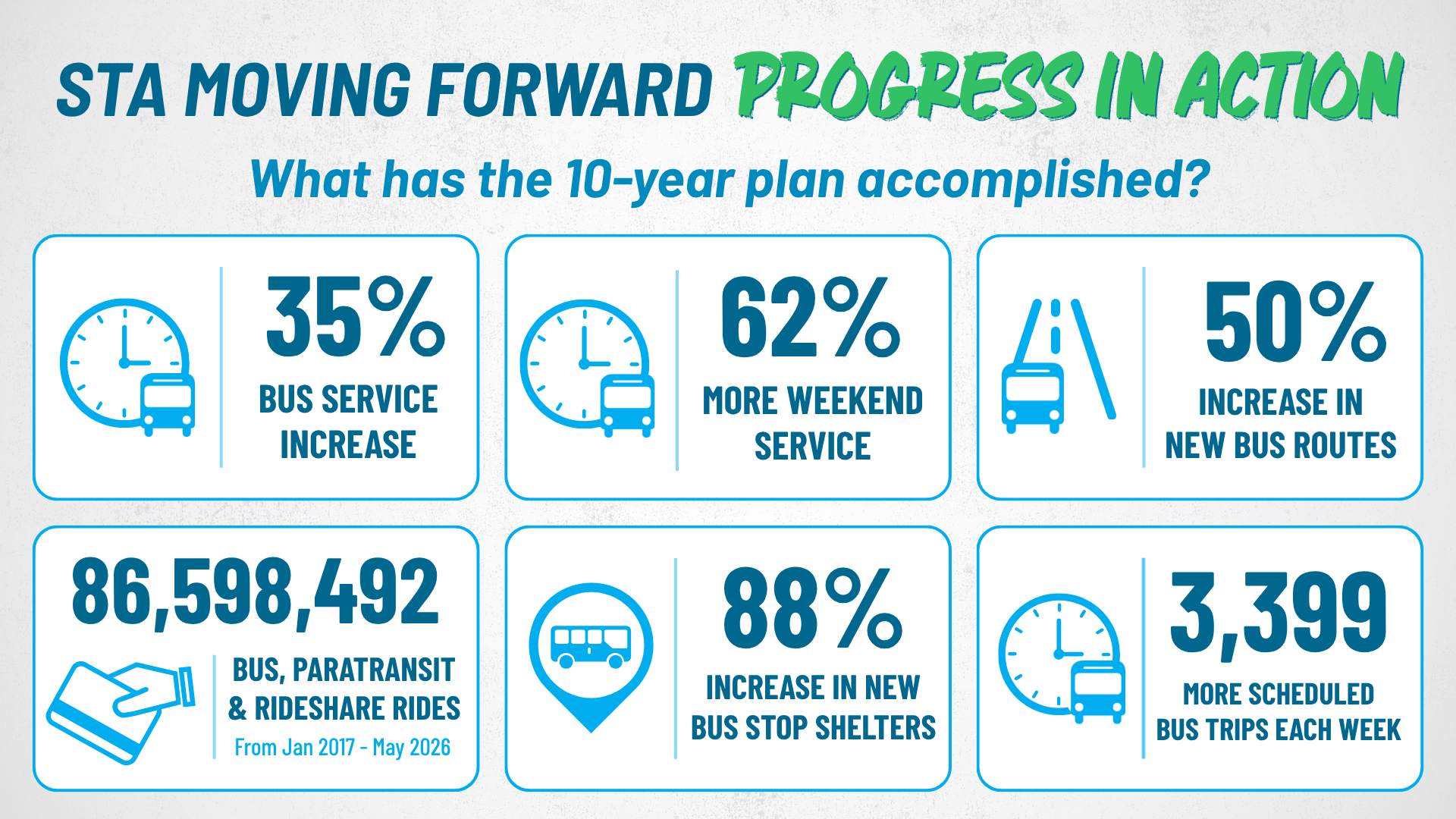
STA Moving Forward was made possible by voter approval in November 2016 of a 0.2% sales and use tax and matching state and federal grants. STA delivered 26 projects outlined in the plan including the implementation of over a dozen new routes, increasing total service hours across the system by over 35%. Weekend service increased by 62%, and Saturday evening service was extended past 10:00 PM across the system. Though the resolution recognizes the official conclusion of the plan, the implementation of these new routes and higher frequency service represents an ongoing legacy of STA Moving Forward. STA has launched an interactive map highlighting major elements of these improvements.
“STA’s ridership growth has significantly outpaced national trends following the COVID-19 pandemic, with ridership levels surpassing pre-pandemic levels, while the national transit ridership has recovered more slowly,” said STA CEO Karl Otterstrom. “While ridership growth is notable, what’s more important is that the service we offer today reaches more jobs, connects more neighborhoods, and provides greater service frequency and value to our riders and taxpayers than ten years ago. We’re grateful for the community’s support of public transportation.”
Connecting People to Services
Through STA Moving Forward, transit service was extended to new medical facilities and other community destinations, including healthcare services along Indiana Avenue east of Sullivan Road, an area of Spokane Valley that had no fixed-route bus service prior to 2017. High Performance Transit (HPT) improvements on key corridors, including the Cheney Line and Monroe-Regal corridor, and the implementation of the region’s first Bus Rapid Transit (BRT) route, City Line, provide fast and frequent service to key services, including education.
Connecting Workers to Employment
STA Moving Forward also expanded transit connections to key employment centers on the West Plains, in Spokane Valley, and in Liberty Lake. Construction of major transit facilities, including the West Plains Transit Center, Moran Station Park & Ride, Spokane Community College Transit Center, and Mirabeau Transit Center, reduced travel time and improved connection to these employment centers. Extended service hours, particularly during evenings and weekends, have improved access to jobs for residents who rely on public transportation as their primary means of travel.
Advancing Regional Economic Development
STA’s investments have contributed to economic development by improving access to both established and emerging employment centers. The City Line BRT corridor has strengthened mobility through central Spokane, supporting the University District, downtown Spokane, and neighborhood revitalization efforts while creating more efficient transportation options for riders. Expanded infrastructure such as passenger shelters, sidewalks, and upgraded maintenance facilities has not only improved the rider experience, but has also supported long-term system growth.
“STA Moving Forward represents one of the most significant transportation investments in our region’s history,” said STA Board Chair and City of Medical Lake Councilmember Lance Speirs. “Thanks to the support of voters, we have expanded access to jobs, healthcare, education, and essential services while building the infrastructure needed to support our region’s continued growth.”
Improvements made throughout the Public Transportation Benefit Area thanks to STA Moving Forward can be found on spokanetransit.com/sta-moving-forward-achievements and on attached infographic.
Over the next decade, STA will create a more accessible, reliable, and connected transportation network with the current strategic plan, Connect 2035. The projects and core investments in Connect 2035 will build on the momentum from the last nine years, shaping the future of mobility in our region. For more information about Connect 2035 and to read the full plan, visit staconnect2035.com.
###
Spokane Transit provides public transportation services through fixed route (bus) service, Paratransit service, and Rideshare to the cities of Airway Heights, Cheney, Liberty Lake, Medical Lake, Millwood, Spokane, and Spokane Valley, and parts of the unincorporated County.
The organization employs over 800 people and is overseen by a 14-member regional board: nine voting elected officials from jurisdictions within the Public Transportation Benefit Area, four non-voting elected officials from area small cities, and a non-voting labor representative.
MEDIA CONTACT:
Carly Cortright, Chief Communications & Customer Service Officer
Email: [email protected]
Office: (509) 344-1879 • Cell: (509) 768-3782

